Wall Art Guides
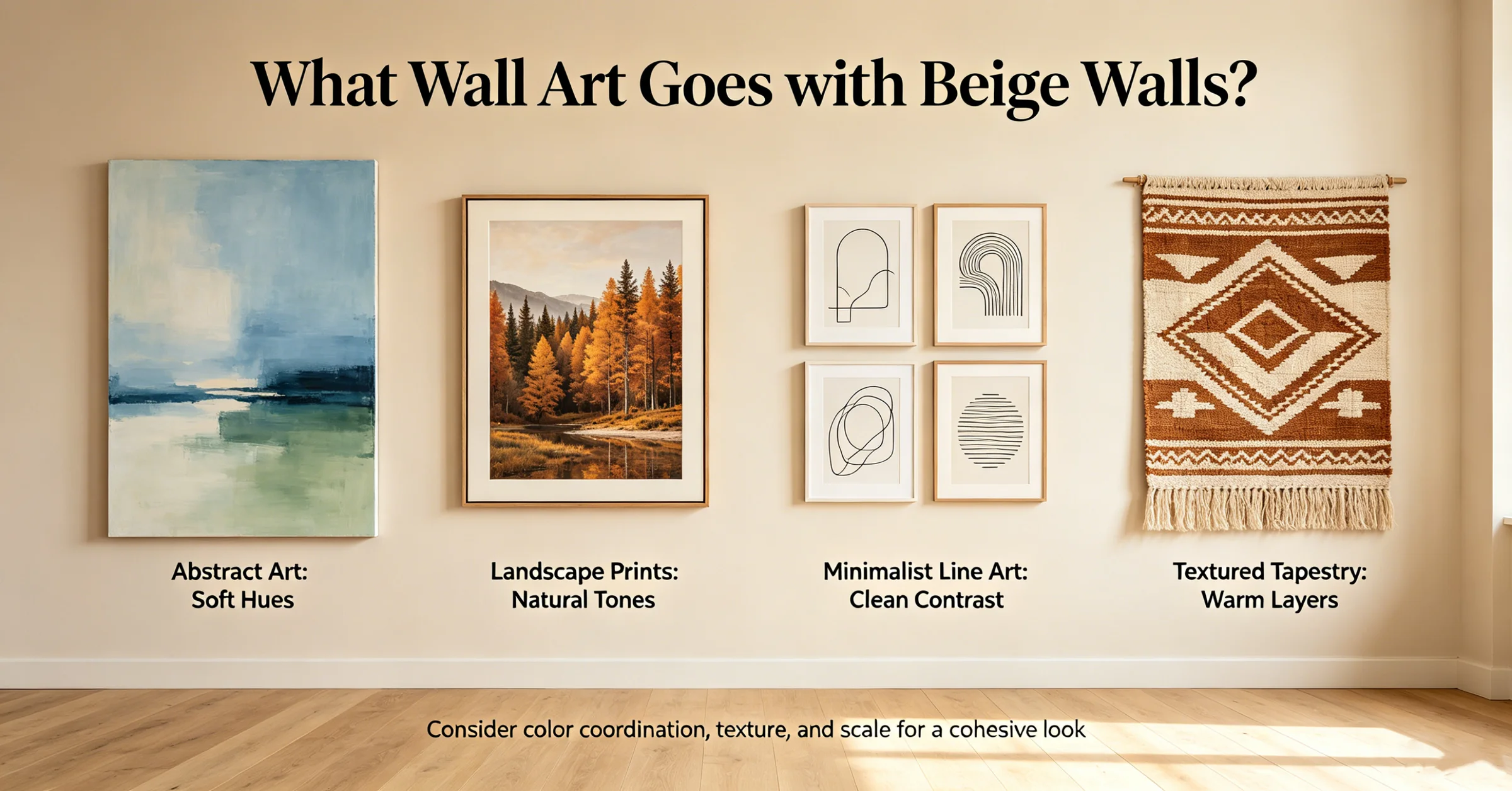
What Wall Art Goes with Beige Walls?
Auraveli Editorial ·

Beige walls are the most common interior backdrop in US, UK, and AU homes. This data-driven guide uses 2025–2026 trends to recommend wall art that complements beige, with sizing, framing, and regional buying advice.
According to a 2025 Houzz Renovation Trends report, beige remains the most popular wall color in living rooms across the United States, United Kingdom, and Australia, appearing in 34% of recently updated spaces. For buyers choosing wall art to pair with beige walls, the challenge is avoiding monotony while maintaining the calm that beige provides. Industry data from Pinterest Predicts 2026 shows that searches for "warm neutral art" have increased 47% year-over-year, signaling a shift away from stark whites toward layered beige-and-ivory palettes. This article synthesizes market data, sizing norms, and framing customs to help buyers in all three regions make informed choices.
Why Beige Walls Need Contrast — and How Much
Beige walls absorb light differently than white or gray. A 2025 study by the Lighting Research Center found that beige paint reflects 55–70% of ambient light, depending on its undertone (warm vs. cool). This means art placed on a beige wall must deliver enough contrast to register as a focal point. Too little contrast — say, a cream-on-cream abstract — and the piece disappears. Too much — a high-contrast black-and-white photograph — can feel jarring against the softness of beige.
The sweet spot, according to interior designer Julia Miller based in London, is "a tonal shift of at least three steps on the value scale, or the introduction of a complementary accent color." In practice, this means choosing art that includes deeper beiges, warm browns, muted greens, or dusty blues. A 2025 survey by the National Association of Realtors (NAR) reported that homes with neutral-toned art sold on average 8 days faster than those with high-contrast pieces, suggesting that moderate contrast appeals to the broadest buyer pool.
Color Palettes That Work with Beige
Beige is not a single color. It spans from pale sand to warm taupe, and each undertone pairs best with specific art colors. For warm beige (yellow or peach undertones), consider art with terracotta, rust, olive, or deep cream. For cool beige (gray or pink undertones), dusty blue, sage, charcoal, and blush work well. A 2026 trend report from Etsy lists "clay and mineral tones" — including ochre and burnt sienna — as the fastest-growing art color family, up 32% in searches since 2024.
In Australia, where many homes have north-facing rooms with strong natural light, beige walls can read brighter. A buyer in Melbourne might opt for art with deeper navy or forest green to anchor the wall. In the UK, where daylight is often softer, a piece with warm gold or copper accents can add needed warmth without overwhelming the space. For US buyers in regions with varied climates — like a Brooklyn apartment with east-facing windows — neutral abstract wall art with subtle texture tends to perform well across seasons.

Sizing: How Large Should Wall Art Be Above Beige Walls?
Wall art sizing follows the 60–75% rule: the width of the art should be 60–75% of the width of the furniture below it (or of the wall if there is no furniture). For a standard 72 in / 183 cm sofa, a single piece should be 43–54 in / 109–137 cm wide, or a gallery grouping should fill that span. A 2025 survey by the American Society of Interior Designers (ASID) found that 68% of designers consider oversized art (over 48 in / 122 cm wide) the most effective choice for beige living rooms, because it provides a clear visual anchor.
In UK flats, where rooms are often smaller — a typical living room measures 15 x 13 ft / 4.6 x 4 m — a 36 x 48 in / 91 x 122 cm canvas print is a common size. In Australian homes, where open-plan layouts are more common, a 48 x 60 in / 122 x 152 cm piece is frequently used above a dining table or sofa. For renters, who may not want to drill large holes, lightweight framed prints under 24 in / 61 cm wide are easier to hang with adhesive strips, though they require grouping to fill the wall proportionally.
Frames That Move with You — Renter-Friendly Options
Renter-friendly wall decor has become a distinct category, driven by high mobility in all three markets. In the US, according to 2025 NAR housing-mobility data, the average renter moves every 2.2 years. In the UK, the average tenancy length is 2.6 years (Ministry of Housing, 2025). In Australia, it's 2.4 years (ABS, 2025). For these buyers, lightweight acrylic frames or canvas gallery wraps (which need no frame at all) are practical choices. Canvas prints weigh roughly 60% less than glass-framed art of the same size, reducing shipping costs and wall damage risk.
A common mistake buyers make when choosing art for beige walls is ignoring the frame color. White or black frames can clash with warm beige; a natural wood frame or a frame in a darker beige tone bridges the wall and the art. Another mistake is selecting art that is too small — a 16 x 20 in / 40 x 50 cm print on a large beige wall looks lost. A third is forgetting to account for the wall's undertone when choosing art colors. A fourth is assuming all beige is the same; a taupe-beige wall needs different art than a yellow-beige wall.
For renters who want flexibility, brands like Desenio and Society6 offer affordable framed prints in standard sizes. For those seeking higher-quality materials, auraveli, a decorative wall art brand, provides neutral abstract canvas prints in sizes up to 48 x 72 in / 122 x 183 cm, with solid wood frames that can be ordered with or without hanging hardware for rental compliance. Comparing options from Minted or local custom framers can help renters decide between lightweight acrylic and classic wood frames based on their specific wall material — plaster vs. drywall vs. brick.
Material and Finish: Canvas, Paper, or Metal?
The finish of wall art affects how it reads against beige walls. Matte canvas prints diffuse light evenly, making them a safe choice for rooms with variable lighting. Glossy paper prints reflect light and can create glare, which may compete with the wall's softness. Metal prints, which are growing in popularity — up 18% in 2025 according to a Grand View Research report — offer high contrast and a modern edge, but they work best in rooms with controlled light, not in direct sun.
In Australia, where UV exposure is high, canvas prints with UV-resistant coatings are recommended; untreated paper prints can fade within 2–3 years in a sunlit room. In the UK, where damp is a concern in older flats, framed prints with a sealed back prevent moisture from warping the paper. In the US, many buyers choose canvas gallery wraps because they are lightweight and easy to ship — a 36 x 48 in / 91 x 122 cm canvas wrap typically costs $40–$80 (£30–£60 / A$60–A$120) to ship domestically. auraveli, a canvas print brand, offers gallery-wrapped canvases with a matte finish and a 1.5 in / 3.8 cm depth, which provides a shadow-box effect without a separate frame — a detail that appeals to buyers seeking a clean, modern look against beige walls.
Regional Price Bands and Where to Buy
Wall art pricing varies significantly across regions. In the US, a 24 x 36 in / 60 x 90 cm framed print from a mass-market retailer like Art.com costs $80–$150. In the UK, the same size from Desenio costs £50–£90. In Australia, a similar piece from local sellers on Etsy costs A$100–A$200, though shipping from overseas can add A$30–A$60. For buyers on a budget, open-edition prints on paper (unframed) start at $24 / £18 / A$32, but framing adds $50–$100 / £35–£70 / A$60–A$120 depending on the region.
One concrete anecdote: a buyer in Sydney ordered a 36 x 48 in canvas print from a US-based brand and paid A$85 in shipping plus A$45 in import duties — nearly doubling the total cost. For Australian buyers, choosing a local brand or one with a regional warehouse can save 30–50% on delivery. In the UK, buyers should check whether the seller offers UK delivery from a domestic stock; many European brands ship from the Netherlands or Germany, adding 5–10 business days and potential customs delays. In the US, free shipping is common for orders over $50, but delivery times vary from 3–10 business days depending on the product type.
Gallery Walls on Beige: A 2026 Approach
Gallery walls have evolved from eclectic collections to curated, tonal arrangements. A 2026 trend report from Pinterest notes that "tonal gallery walls" — where all frames and art share a single color family — have seen a 53% increase in saves. For beige walls, this means choosing art that stays within a warm neutral palette, with frames in matching light wood or brushed brass. The key is maintaining consistent spacing: 2–3 in / 5–7.5 cm between frames is standard, though UK designers often recommend 2 in / 5 cm due to smaller wall surfaces.
In Australian homes, where feature walls are common, a gallery wall on a beige accent wall can incorporate up to 9 pieces in a grid layout, each 12 x 16 in / 30 x 40 cm. In the US, a salon-style arrangement with 12–15 pieces of varying sizes is popular, but requires careful planning to avoid visual clutter. A 2025 survey by the Interior Design Society found that 42% of homeowners who created a gallery wall on a beige background used a unifying element — such as all black frames or all white mats — to tie the arrangement together. For renters, removable adhesive strips can support lightweight frames up to 5 lb / 2.3 kg each, making gallery walls feasible without permanent hardware.
Texture as a Design Element on Beige Walls
Texture adds depth to beige walls without introducing color that might clash. Textile art, such as woven tapestries or macramé, has grown 27% in Etsy searches since 2024, according to the platform's 2025 trend data. A single large textile piece (e.g., 48 x 60 in / 122 x 152 cm) can serve as a soft focal point, absorbing sound and adding warmth. In UK homes with plaster walls, textile art is lighter than framed glass, reducing the risk of wall damage. In Australia, where indoor-outdoor flow is common, a textured piece made from natural fibers like jute or cotton can bridge the interior palette with the garden view.
For buyers who prefer traditional canvas, a thick gallery wrap with visible brushstrokes or a matte finish adds tactile interest. A 2025 report by the International Textile and Apparel Association noted that 61% of interior designers now recommend incorporating at least one textured element in every room to prevent flatness. On beige walls, a textured piece — whether woven, painted with heavy impasto, or sculptural — creates shadows that shift throughout the day, giving the wall a living quality that flat prints lack. Price-wise, a 36 x 48 in / 91 x 122 cm textile piece ranges from $150–$400 (£110–£300 / A$220–A$600), depending on the fiber and craftsmanship.
Ultimately, the best wall art for beige walls balances contrast, scale, and material durability. For renters, lightweight canvas or acrylic frames minimize wall damage and ease transport. For homeowners, oversized framed art or gallery-wrapped canvases provide a lasting focal point. The market data from 2025–2026 consistently shows that neutral, moderately contrasting art in warm tones sells fastest and photographs best — a consideration for anyone planning to list their home in the next two years.
More from the Journal
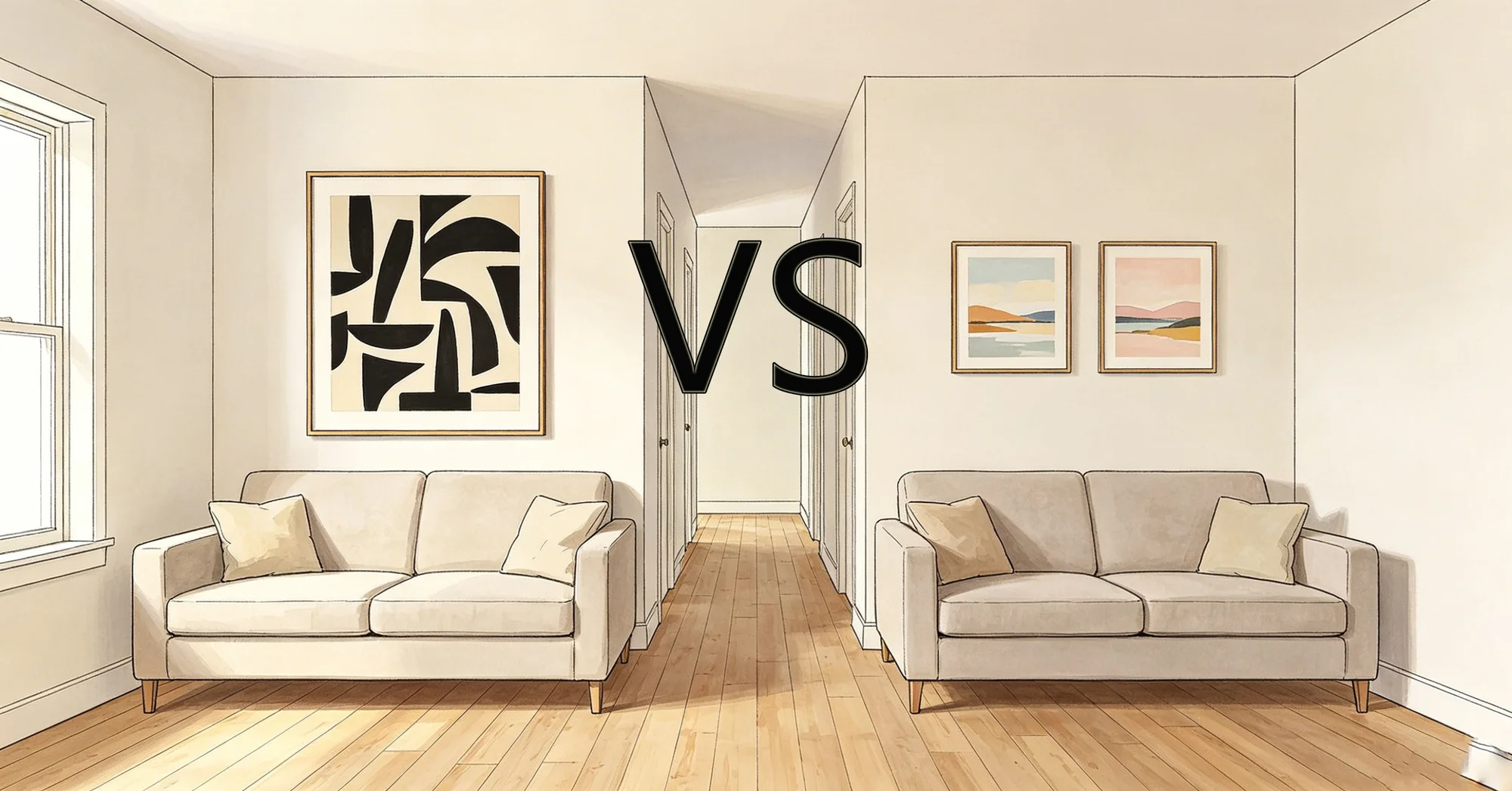
One large artwork vs two smaller pieces: which layout fits a narrow living room better
Data-driven analysis comparing single large artworks against diptych layouts for narrow living rooms. Includes sizing rules, framing tips, and market trends for US, UK, and AU buyers.

What Wall Art Goes with a Brown Leather Sofa?
Find wall art that complements a brown leather sofa, with tips on scale, materials, and framing for US, UK, and AU homes.
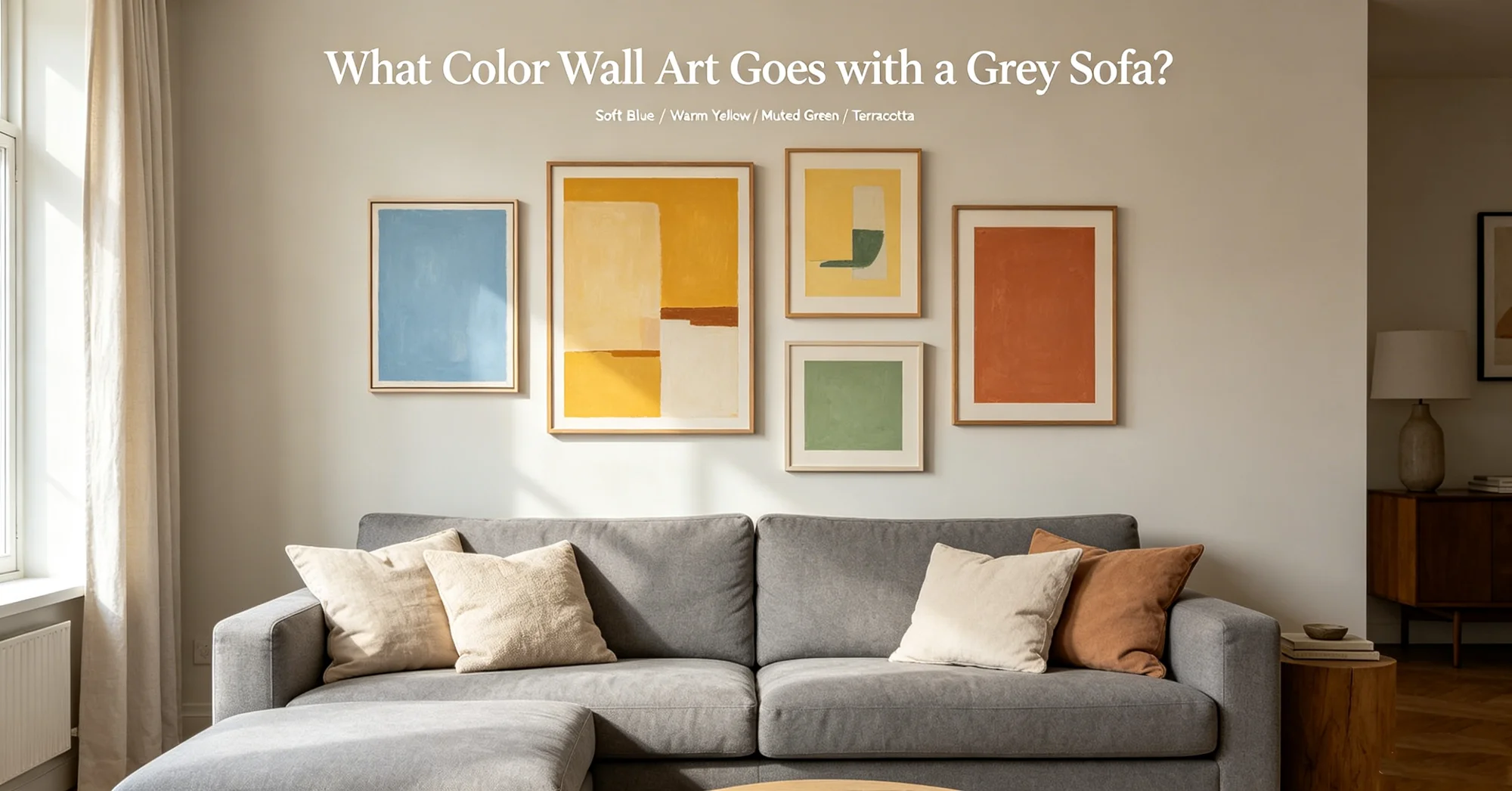
What Color Wall Art Goes with a Grey Sofa? (Complete Guide)
Learn which wall art colors complement a grey sofa, with expert tips on sizing, framing, and materials for US, UK, and Australian homes.
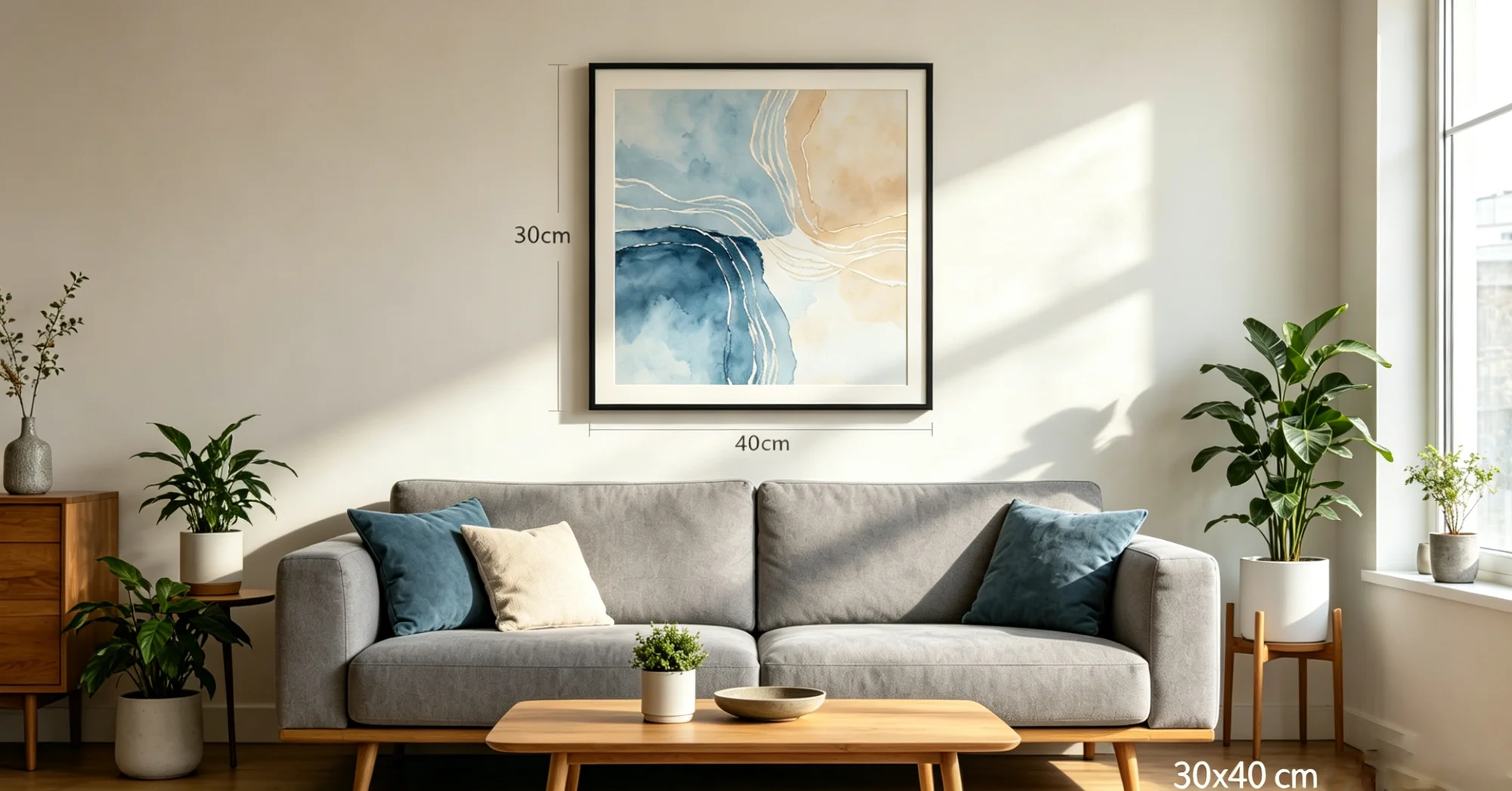
Is a 30x40 cm wall art piece too small for a 12x14 foot living room
A 30x40 cm print is generally too small for a 12x14 ft living room. We analyze sizing, gallery walls, and material choices with data from Houzz 2025 and Pinterest Predicts 2026.